Does My Baby Have a Milk Protein Allergy
More and more children are developing food allergies. Did you know, cow milk protein is the most common food allergen in early childhood? It's even more prevalent in infancy than peanut allergy. In fact, more than than 100,000 babies each year – 2-5% of infants – suffer from this allergy in the US. Cow milk allergy (CMA) can too be chosen milk protein allergy, milk poly peptide intolerance or moo-cow milk protein allergy (CMPA). Desire even more acronyms? Infants allergic to both milk and soy: milk soy protein intolerance (MSPI) or multiple food allergies (MFA). With such prevalence, do yous know the common signs and symptoms of a cow milk allergy?
Children with a cow milk allergy often experience several signs and symptoms. These can affect multiple body parts, or systems (digestive, skin, respiratory or general). These are non specific to CMA, meaning they tin signal other atmospheric condition. That makes CMA difficult to identify. First you must place the cause of these signs and symptoms, then you tin manage the condition and symptoms.
Parents ofttimes tell united states they waited months earlier their child was officially diagnosed with CMA. This oftentimes involves multiple doc visits with few answers. Being able to spot possible signs of CMA may lead to recognizing it earlier. That can hateful quicker solutions, oftentimes a hypoallergenic amino acid-based formula like Neocate®.
When to Inquire if Your Baby Might Have a Moo-cow Milk Allergy?
The following video outlines 8 signs and symptoms that may cause a healthcare team to suspect CMA. The list comes from a Lath-certified pediatric allergist.
This is certainly not a comprehensive listing – some signs and symptoms are less common. Also, not every infant with one or more of these signs volition exist diagnosed with CMA. Finally, every baby who develops an allergy will have a unique feel.
Now, let'south dive a bit deeper into eight mutual signs of a moo-cow milk allergy. Parents who meet these in their baby can ask the medico if they might indicate CMA.
Digestive: Persistent Diarrhea or Constipation
Diarrhea tin be very apropos to someone caring for an infant. Every infant has loose stools from fourth dimension to time. However, if you come across multiple loose or liquid stools a mean solar day, it could betoken a milk allergy. ("Multiple" = average of ii-iv times a twenty-four hour period for more than than 5-7 days.) Over one-half of children with CMA can take diarrhea, the nigh common digestive symptom.
Call back: diarrhea has many causes. Ask your healthcare team if you retrieve your little 1 has diarrhea. Hither are smashing resources with more detail virtually baby bowel movements:
- Diarrhea and its link to CMA
- Rail babe poop with Neocate® Footsteps® App
- What is normal and what is not when it comes to baby poop
- What color should baby poop be?
Believe it or not, constipation can also bespeak CMA in infants. While constipation is a less common sign than diarrhea, it's possible for infants with CMA to accept constipation.
Digestive: Claret and/or Mucus in the Stool
Blood in the stool is a likely sign of CMA in infants. The blood results from inflammation in the gut. It can appear in the diaper as either red or black. Red claret means the haemorrhage is in the lower terminate of the gut. Black color normally signals haemorrhage higher up, like from uncontrolled reflux. If you notice red or black in your baby's diaper, telephone call the doctor.
Mucus looks like what comes out of your nose when you have a cold or runny nose. It looks sticky when yous open the diaper. A little flake tin exist normal, but if yous run across a lot or it lasts a while, it can signal a food allergy.
Digestive: Frequent Vomiting, Reflux or Spitting Up
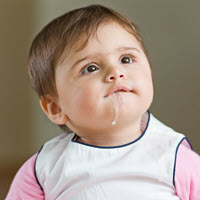 Babies often spit up (or "regurgitate"), but annihilation beyond the occasional post-repast spit-upwardly should be examined by a medico. Many infants who spit upwardly don't seem bothered past it and maintain a healthy weight – we call them "happy spitters." For other infants, spitting up may stand for something more concerning like gastroesophageal reflux affliction (GERD) or vomiting. It can lead to low or no weight gain.
In infants, frequent reflux or vomiting can be related to CMA. Virtually 50% of infants with reflux may exist diagnosed with CMA. In those cases, taking cow milk out of the diet should help resolve reflux. Read more information on reflux and vomiting in infancy. (In one extreme allergic condition –Food Protein Induced Enterocolitis (FPIES)– fierce airsickness a few hours subsequently feeding is the authentication sign.)
Digestive: Persistent Gassiness
Gas happens when there is excess air in the stomach or intestines. This can result in discomfort, burping, or passing gas. Discomfort can cause an babe to be "fussy", "cranky", or "colicky." All babies have gas, only when it occurs with several other signs, it signals a possible allergy to cow milk.
Skin: Unexplained Rash
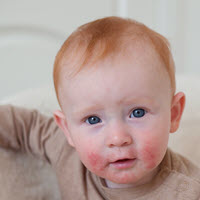 At that place are many causes for skin rashes, similar atopic dermatitis (eczema) or hives (urticaria). CMA is a possible crusade, peculiarly when other CMA signs are present. Upward to lxx% of infants with CMA have skin-related signs. Rashes related to CMA may be very uncomfortable, with nonstop itching and scratching. This may exist worse afterwards feedings.
Rashes oft appear on the face, but tin appear anywhere on the body. Call back, it is important to check with your child'south physician if you suspect the rash to be related to CMA. For more information about peel rashes and when it might betoken CMA, check out Baby Rashes from Acne to Eczema.
Respiratory Bug
Children can have dissimilar respiratory issues with CMA. Up to 30% of infants with CMA have respiratory signs. These generally fall into 2 types; either mild or severe.
- Mild–Includes runny noses, sneezing, and nasal congestion. These expect similar what you lot might see when your child has a cold.
- Severe–Includes shortness of breath, struggling to breathe or wheezing: all need immediate attending. Shortness of jiff can wait like sudden and/or astringent gasping or difficulty breathing. Your child may look to be in pain and frightened. Wheezing is a whistling or rattling sound in the chest when a child breathes. Both betoken obstructed airways. If your child shows a astringent respiratory symptom, seek immediate medical assistance.
The scariest respiratory symptom of all is the shortness of breath that occurs with anaphylactic daze. Anaphylaxis is a sudden reaction to a food allergen. This requires immediate attending, every bit problem animate tin can quickly go life-threatening.
The post-obit post related to food allergies and asthma – an allergic status that affects breathing – may be worth a look: Allergies and Asthma: What'due south the Link?
General: Excess Fussiness, Sleeplessness or "Colic"
 Every infant cries, only crying continuously and inconsolably for extended periods is unusual. Yous might hear someone say a babe who cries a lot has colic. Some doctors find colic controversial, but excess crying comes from somewhere, oftentimes with indisposition. Doctors too often downplay fussiness, which tin delay diagnosing CMA. We hear this from parents all also ofttimes!
When should you lot suspect that crying is excessive ("colic") and something serious is happening? The going aphorism is to talk to the doctor if it happens in threes. That is: if your infant cries for 3+ hours in a day, for three+ days in a week, for over 3 weeks. That can signal gastrointestinal hurting, which could result from CMA.
Farthermost fussiness can also come with reflux, a rash, or other factors. Keep this in heed when asking your child's doctor well-nigh the possibility of CMA.
General: Low or No Weight Gain or Failure to Thrive (FTT)
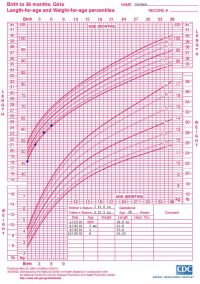 Most infants double their birth weight past six months and triple it by 12 months. Each dot on a growth chart is a percentile. The dots grade a growth curve that shows a pattern of growth relative to the population. A child's head circumference, weight, and meridian (length, for infants) generally follow a consistent trend over time.
Sometimes though, slow weight gain may atomic number 82 to a diagnosis of 'Failure to Thrive' (FTT), which is one of the symptoms of a cow milk allergy. Tedious weight gain is gaining weight more slowly than other children the aforementioned age and gender.
Many factors contribute to slow weight gain, and oftentimes several factors are at play. Food allergy reactions tin cause bug digesting or absorbing nutrient, leading to failure to thrive. For example, babies may not get the nutrition they need because of excessive diarrhea or airsickness. The body may not get all the nutrients needed, which tin can mean they tin't grow as quickly as they should.
As always, ask your child'southward healthcare professional person if yous are concerned about your child'southward weight.
MY Baby HAS ONE OR More SYMPTOMS OF A COW MILK ALLERGY
WHAT SHOULD I DO?
Enquire the healthcare team! The ideal way they confirm the symptoms of a cow milk allergy is to:
- Remove moo-cow milk from the diet, and
- Re-introduce moo-cow milk, ofttimes under a doctor'southward supervision.
Many doctors won't go past footstep i if signs better. However, step 2 is the best manner to confirm a nutrient allergy. If you add cow milk back to the diet and symptoms reappear, CMA can be diagnosed.
Babies allergic with symptoms of a moo-cow milk allergy who require formula demand i that'south hypoallergenic, similar Neocate® Syneo® Baby. Neocate is safe for babies with food allergies because it contains amino acids, building blocks of protein. Amino acids can't trigger an allergic reaction the way proteins or peptides in other formulas can. (Read virtually formula types.)
If you lot suspect CMA, inquire your kid's physician for a thorough evaluation. Bring this data with you and ask your doctor if your babe might do good from Neocate. For more on CMA, check out the following resources:
- CMA Symptom Checker
- CMA Guidelines
- The Deviation Between CMA and Lactose Intolerance
- Outgrowing CMA
Published: 05/07/2018
Source: https://www.neocate.com/living-with-food-allergies-blog/8-signs-milk-allergy/
0 Response to "Does My Baby Have a Milk Protein Allergy"
Post a Comment